The Hidden Cost of Missing Medical Equipment: How Hospitals Lose Millions to "Ghost Equipment"
By Sourav Das•July 2026
Quick Answer
Ghost equipment refers to medical assets that still exist in a hospital's inventory or financial records but can no longer be physically located. These may include infusion pumps, monitors, wheelchairs, and other mobile devices that are moved between departments, lost in storage, or quietly disposed of without an updated record. Research indicates that 10–20% of a hospital's mobile assets are lost or stolen during their useful life, at an average replacement cost of roughly $3,000 per item. A typical 300-bed hospital can lose an estimated $1–2 million annually on missing equipment alone. Centralized, real-time asset tracking helps eliminate this visibility gap by maintaining an updated record of each device's location, condition, and lifecycle status.
What Is "Ghost Equipment" in Hospitals?
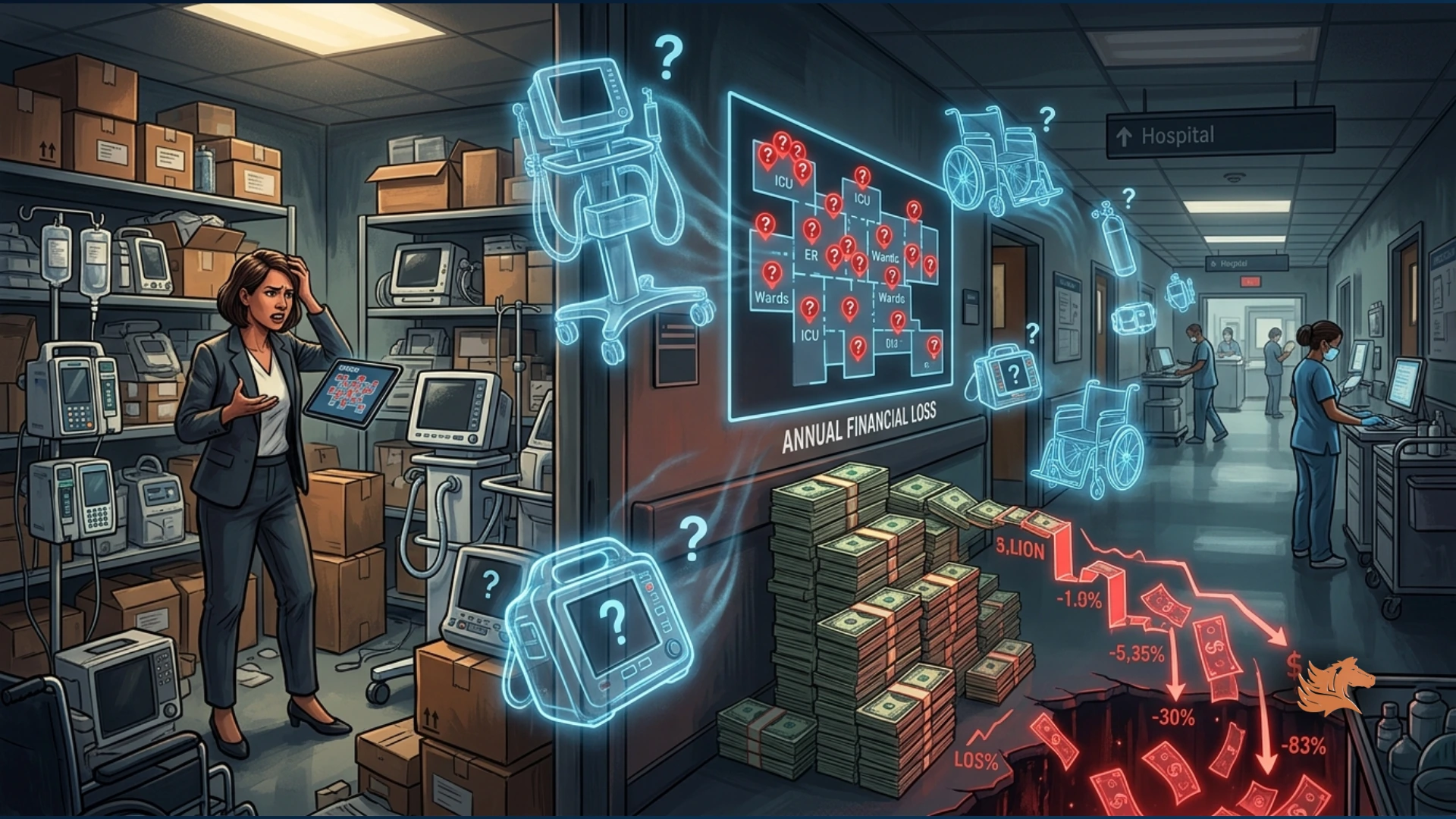
Ghost equipment is any medical asset that a hospital's records say it owns, but that staff cannot physically locate when needed.
It typically falls into three categories:
1. Misplaced Equipment
Devices moved between units, floors, or departments without an updated location record.
2. Hoarded Equipment
Staff who are tired of hunting for shared devices may quietly stash pumps or monitors in their own unit's supply closet as a rational, if inefficient, response to an unreliable system.
3. Disposed or Retired Equipment
Assets removed from service but never formally taken off the books, causing them to continue appearing as active inventory.
How Much Does Ghost Equipment Actually Cost Hospitals?
The financial impact of ghost equipment is well documented across healthcare asset management research, and the losses can be much larger than administrators expect.
The result is a gap between the hospital's recorded asset count and its actual usable equipment — a gap that directly translates into wasted spending.
Cost Category
Impact
Emergency equipment rental/replacement
~$3,000 per lost or stolen item, on average
Duplicate purchasing
Hospitals overbuy 20–30% of devices to offset hidden inventory
Clinical time loss
Up to 1 hour per shift searching, contributing to billions in lost productivity nationally
Underutilization
Roughly 40% of equipment sits idle or duplicated
Compliance and audit risk
Inability to verify equipment maintenance and calibration records
Preventive maintenance gaps
Devices can be missed during scheduled servicing because their location is unknown
Key Takeaway
Ghost equipment creates a gap between what a hospital believes it owns and what is actually available, leading to unnecessary purchases, rentals, lost clinical time, underutilization, and compliance risks.
Why Does Ghost Equipment Keep Happening?
Ghost equipment is not caused by staff negligence. It is caused by the absence of a real-time tracking system in an environment where equipment moves constantly.
The most common root causes include:
Manual, Spreadsheet-Based Inventory
Static records cannot keep up with equipment that moves dozens of times a day across a large healthcare facility.
No Standardized Check-In/Check-Out Process
Devices leave storage without any digital trail showing where they went.
Fragmented Departmental Ownership
Different units purchase and track equipment independently, creating limited hospital-wide visibility.
Hoarding as a Coping Mechanism
When staff are not confident equipment will be available when needed, they may stash devices locally, which deepens the shortage system-wide.
Retired Assets Left on the Books
Disposed equipment is not formally removed from inventory, inflating recorded asset counts that no longer reflect reality.
How Do Hospitals Eliminate Ghost Equipment?
The solution is shifting from static, manual inventory records to a centralized, continuously updated asset management system.
This is the visibility gap that a platform like AssetPegasus is designed to address for healthcare facilities.
1
Full Equipment Lifecycle Tracking
AssetPegasus maintains a single record for every medical asset, including purchase date, department assignment, service history, and current condition.
This replaces scattered spreadsheets with one accurate source of truth for hospital equipment.
2
Real-Time Location and Status Visibility
Instead of relying on staff memory or manual logs, AssetPegasus keeps equipment records continuously updated.
This directly addresses the visibility gap associated with lost, hoarded, and underutilized inventory.
3
QR Code Scanning for Instant Verification
Staff can scan a QR code directly on a device to confirm its identity, location history, and maintenance status in seconds.
This turns equipment checks into a fast verification task instead of a floor-by-floor search.
4
Automated Preventive Maintenance Scheduling
AssetPegasus automates maintenance scheduling so every tracked device can be serviced and calibrated on time.
This helps close the compliance gap created by equipment that maintenance teams cannot locate.
5
Warranty and Insurance Tracking
Built-in warranty and insurance tracking helps hospitals avoid paying out of pocket for repairs or replacements on equipment that is still covered.
This is especially important when missing equipment and poor asset visibility already make warranty information difficult to verify.
6
Multi-Department, Cloud-Based Dashboard
For hospitals and health systems with multiple facilities, AssetPegasus provides one cloud dashboard showing equipment status and location trends across departments and sites.
This gives healthcare organizations centralized visibility without requiring separate local systems.
7
Compliance-Ready Documentation
AssetPegasus is built with GDPR- and HIPAA-aligned data handling, helping hospitals stay audit-ready for equipment calibration, maintenance, and safety compliance requirements.
8
Measurable Capital Savings
Healthcare facilities using centralized asset management platforms like AssetPegasus commonly report cutting equipment-related operational costs by up to 40%.
Potential savings come from eliminating duplicate purchases, unnecessary rentals, and untracked equipment losses.
Manual Inventory vs. Centralized Asset Tracking
Requirement
Manual/Spreadsheet Tracking
Centralized Tracking (AssetPegasus)
Location accuracy
Outdated within hours
Continuously updated
Staff search time
Up to 1 hour per shift
Seconds via QR lookup
Maintenance compliance
Frequently missed on lost assets
Automated, scheduled
Warranty capture
Often missed
Tracked with proactive alerts
Capital visibility
Fragmented by department
Unified across the facility
Conclusion
Ghost equipment is ultimately a visibility problem. Hospitals can reduce unnecessary purchases, rentals, equipment loss, clinical search time, and compliance gaps by maintaining a centralized and continuously updated record of every medical asset. With real-time tracking, QR-based identification, lifecycle management, maintenance scheduling, warranty tracking, and centralized reporting, healthcare organizations can bring their recorded inventory closer to the equipment actually available on the floor.
Find Out How Much Ghost Equipment Is Hiding in Your Hospital
Start a free 30-day trial with AssetPegasus and identify missing, underutilized, and untracked medical equipment in your inventory.
Share this article
More from our Blog
The High Cost of Unplanned Factory Downtime (and How to Eliminate It)
By Poll Ghosh•July 20, 2026
Ghost Assets on Construction Sites: How Moving Machinery Unnoticed Drains Profitability
By Sourav Das•July 2026
Why Restaurants Pay Twice for Equipment Repairs (and How Warranty Tracking Saves Capital)