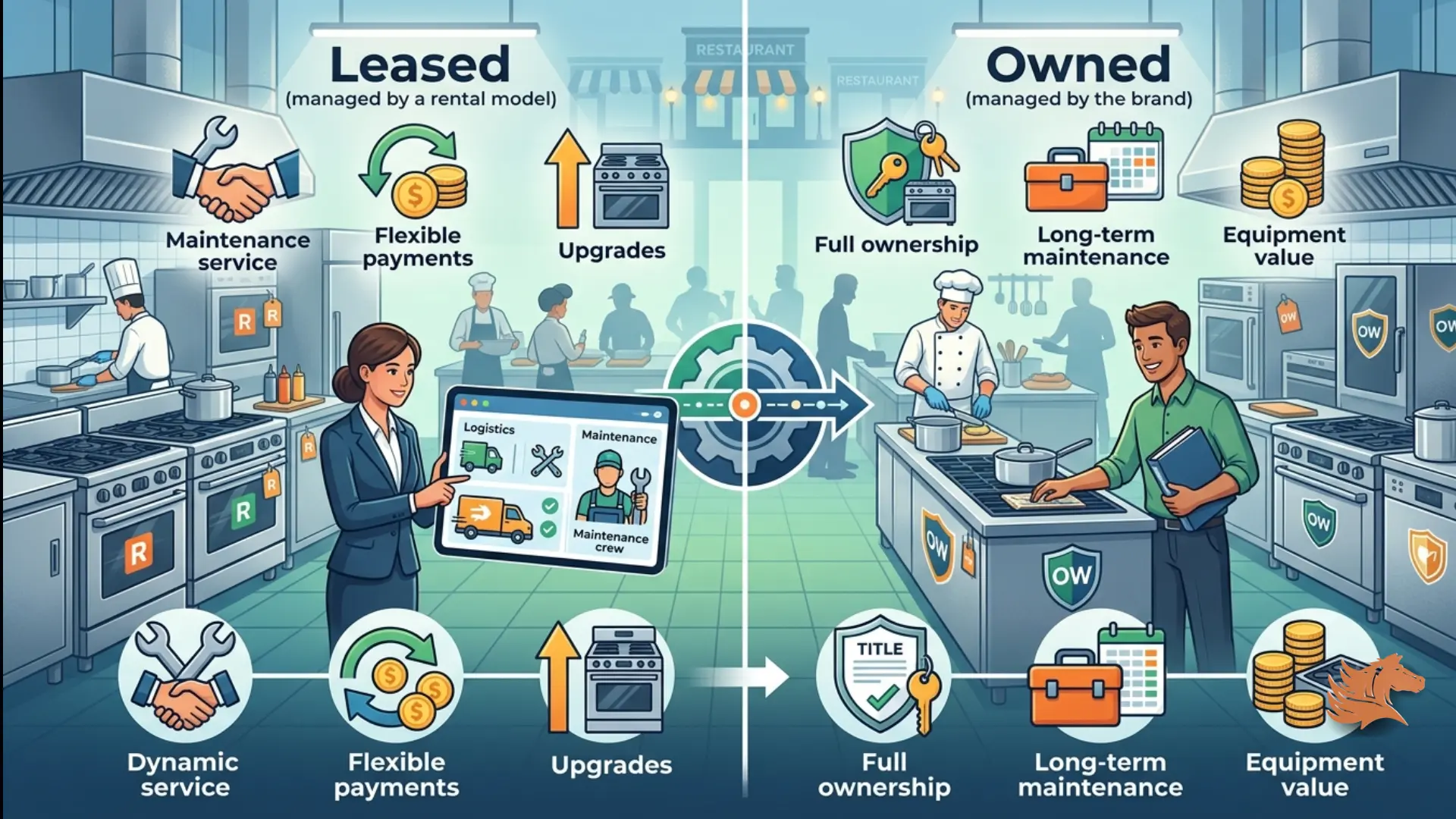
How Multi-Unit Restaurant Brands Manage Leased vs. Owned Commercial Kitchen Equipment
By Asset Pegasus Team•September 24, 2026
Quick Answer
Multi-unit restaurant brands manage leased vs. owned kitchen equipment by tagging every asset with its ownership type, location, and contract terms in a centralized system, so operators always know which equipment is theirs to maintain and which must be returned, serviced, or renewed under a lessor's terms.
The core challenge is that leased and owned equipment carry different obligations: leased units usually have mandatory service schedules, usage limits, and return-condition clauses tied to the lessor's contract, while owned units are the brand's full financial and maintenance responsibility with no return deadline.
Brands that separate these categories at the asset level rather than tracking them in disconnected spreadsheets per location catch lease renewals before auto-extension penalties, avoid double-paying for maintenance already covered under a lease, and get an accurate real vs. leased asset value across the entire portfolio.
Why Does Leased vs. Owned Equipment Tracking Get Complicated for Multi-Unit Brands?
A single-location restaurant can track a walk-in cooler and a few fryers on a spreadsheet. A 40-, 100-, or 500-unit brand cannot, because the equipment mix multiplies across three variables at once: location, ownership type, and vendor contract.
Locations open with different equipment strategies. A newly built unit might lease its full kitchen package from a single vendor, while a converted or acquired location inherits a mix of owned legacy equipment and equipment leased under a prior franchisee's contract that the parent brand now has to honor.
Franchise structures blur ownership. In franchise-heavy brands, some equipment is leased by the franchisor and subleased to the franchisee, some is leased directly by the franchisee, and some is company-owned at corporate locations. Without a system tagging ownership per unit, corporate loses visibility into what it's actually liable for at each site.
Lease terms aren't standardized. Different vendors, signed at different times, carry different maintenance obligations, usage caps, and end-of-term conditions. A fryer leased in 2022 might have different return requirements than one leased in 2025, even from the same vendor.
Maintenance responsibility shifts by contract. Some leases include vendor-performed maintenance as part of the monthly cost; others require the operator to maintain the unit to a specified standard or risk end-of-lease penalties. Mixing these up leads to either paying twice for the same service call or letting equipment fall out of lease compliance.
Key Takeaway
Managing kitchen equipment across dozens or hundreds of units requires maintaining visibility over varying lease contracts, franchisee obligations, and vendor maintenance terms across every location.
What's the Real Difference Between Leased and Owned Kitchen Equipment for Operators?
Leased and owned commercial kitchen equipment carry fundamentally different operational, contractual, and financial obligations for restaurant operators.
Factor
Leased Equipment
Owned Equipment
Maintenance responsibility
Often vendor-managed or contractually mandated
Fully the operator's responsibility
End-of-term obligation
Must be returned in specified condition, or fees apply
No return obligation
Financial treatment
Operating expense, off balance sheet in many structures
Capital asset, depreciated over time
Upgrade flexibility
Easier to upgrade at lease renewal
Requires capital outlay to replace
Usage restrictions
May include usage caps or service-provider requirements
No usage restrictions
Documentation needed
Contract terms, service schedule, condition reports
Purchase record, warranty, maintenance log
Key Takeaway
Distinguishing between leased and owned assets ensures compliance with contractual maintenance rules and avoids costly end-of-term return disputes.
How Do Multi-Unit Brands Track Equipment Ownership Across Locations?
To prevent confusion and financial waste, leading restaurant operators implement standardized asset intake and tracking processes across all stores.
1. Tag Every Asset With Ownership Type at Intake
The moment equipment enters a location—whether delivered under a lease or purchased outright—it gets logged with its ownership status, vendor or lessor name, and location ID. This single field prevents corporate from losing track of what's leased versus owned as the portfolio grows.
2. Attach the Full Contract Terms to the Asset Record
Lease start date, term length, monthly cost, renewal or auto-extension clause, required maintenance cadence, and return-condition requirements all get linked directly to that specific piece of equipment, not stored separately in a contracts folder no one checks.
3. Set Automated Alerts for Lease Milestones
Renewal deadlines, auto-extension windows, and required service dates are flagged well ahead of time. Multi-unit brands that miss these dates are most likely to get locked into unfavorable auto-renewals or hit with unexpected end-of-lease fees.
4. Separate Maintenance Workflows by Ownership Type
For leased equipment under vendor-managed service, work orders route to the vendor and get logged for compliance proof. For owned equipment, work orders route to internal or contracted technicians with full cost tracking, since there's no lessor picking up the bill.
5. Standardize Reporting Across All Locations
Every unit—corporate-owned or franchised—reports equipment status the same way, so regional and corporate teams can see leased vs. owned equipment value, upcoming lease expirations, and maintenance compliance across the entire brand in one view instead of unit-by-unit.
6. Reconcile Equipment Data During Location Openings, Closings, and Conversions
When a unit opens, closes, changes franchisees, or gets remodeled, the equipment list gets audited against what's actually on-site, catching leased equipment that was quietly left behind or owned equipment that was removed without being logged.
7. Use QR or Asset Tags for On-Site Verification
Field managers and technicians scan equipment on-site to instantly see its ownership status, contract terms, and maintenance history—critical during multi-unit audits, franchise transitions, or when a piece of equipment's origin is unclear years after installation.
Key Takeaway
Centralizing equipment intake, tagging, maintenance workflows, and lease milestone alerts enables seamless oversight across corporate and franchised stores.
What Mistakes Cost Multi-Unit Brands Money on Leased Equipment?
Failing to track leased equipment systematically exposes multi-unit operators to compounding financial penalties and unnecessary operating expenses.
Mistake
Financial Impact
Missing lease renewal or auto-extension deadlines
Locked into another full term at above-market rates
Paying for internal maintenance on vendor-serviced leased units
Duplicate maintenance spend across dozens or hundreds of units
Returning leased equipment in non-compliant condition
End-of-lease damage or excess-wear fees per unit
Not knowing which locations still have legacy leased equipment
Unbudgeted return or buyout costs discovered late
Treating leased and owned equipment identically in maintenance planning
Compliance gaps on leased units, wasted spend on owned units
No standardized data across franchise and corporate units
Corporate can't get an accurate liability or asset value picture
Key Takeaway
Inadequate tracking can lead to severe operational leaks, from expensive automatic lease renewals to double payments for routine maintenance calls.
How Does Centralized Asset Management Solve Leased vs. Owned Tracking at Scale?
The core problem for multi-unit restaurant brands isn't understanding the difference between leased and owned equipment—it's maintaining that distinction accurately across dozens or hundreds of locations, each potentially run by different managers, franchisees, and vendors.
AssetPegasus solves this by making ownership type, contract terms, and location a structured part of every asset record, not a note in a separate spreadsheet or filing cabinet.
Each piece of equipment—a walk-in freezer, combi oven, fryer, or ice machine—is logged with its lease or ownership status, the vendor or lessor, contract dates, and required maintenance terms, so the data travels with the asset rather than living with whichever manager happened to set it up.
Automated alerts flag lease renewals, auto-extension windows, and required service dates before they're missed, which is where multi-unit brands most commonly lose money—either through unfavorable renewals or through maintenance non-compliance that triggers end-of-lease penalties.
QR-code asset tags let regional managers, franchisees, and technicians scan any unit on-site and instantly see whether it's leased or owned, who's responsible for maintaining it, and its full service history—useful during routine audits, franchise transitions, or when a unit's history is unclear.
Centralized reporting rolls this up across the entire brand, giving corporate a single view of leased vs. owned equipment value, upcoming lease obligations, and maintenance compliance across every location, whether corporate-owned or franchised.
Key Takeaway
Centralized asset management connects physical kitchen assets directly to their contractual, operational, and financial records for complete portfolio visibility.
Fragmented Tracking vs. Centralized Asset Management
Relying on spreadsheets and siloed location files makes tracking multi-unit kitchen assets cumbersome and prone to error. A modern asset platform standardizes the process.
Requirement
Fragmented (Spreadsheets, Per-Location Files)
Centralized (AssetPegasus)
Ownership status per asset
Inconsistent, often outdated
Logged and current for every asset
Lease renewal visibility
Manual calendar tracking, easy to miss
Automated alerts ahead of key dates
Maintenance routing by ownership
Mixed up between vendor and internal teams
Automatically separated by contract terms
Portfolio-wide equipment value
Difficult to consolidate across units
Available in a single rolled-up view
Franchise vs. corporate visibility
Siloed by location or franchisee
Standardized across the entire brand
Audit and transition readiness
Reactive, assembled after the fact
Continuously accurate, always audit-ready
Key Takeaway
Switching from manual spreadsheets to centralized tracking protects profit margins and ensures continuous audit readiness across all stores.
Conclusion
Multi-unit restaurant brands don't lose money on leased equipment because the concept is complicated—they lose money because leased and owned equipment aren't consistently distinguished, documented, and tracked across dozens or hundreds of locations with different managers, franchisees, and vendors. Tagging every asset with its ownership type and contract terms, automating lease milestone alerts, and routing maintenance correctly based on who's actually responsible for it are what keep a growing brand from bleeding money on missed renewals, duplicate service costs, and end-of-lease penalties. Centralizing this at the asset level, rather than location by location, is what makes it possible to see the true financial picture of the entire equipment portfolio at any moment.
Get a Single View of Every Location's Equipment
Start a free 30-day trial with AssetPegasus and track every leased and owned kitchen asset — with contract terms, maintenance history, and renewal alerts — across your entire portfolio in one system.