How to File Successful Commercial Insurance Claims for Damaged Production Machinery
By AssetPegasus Team•September 13, 2026
Quick Answer
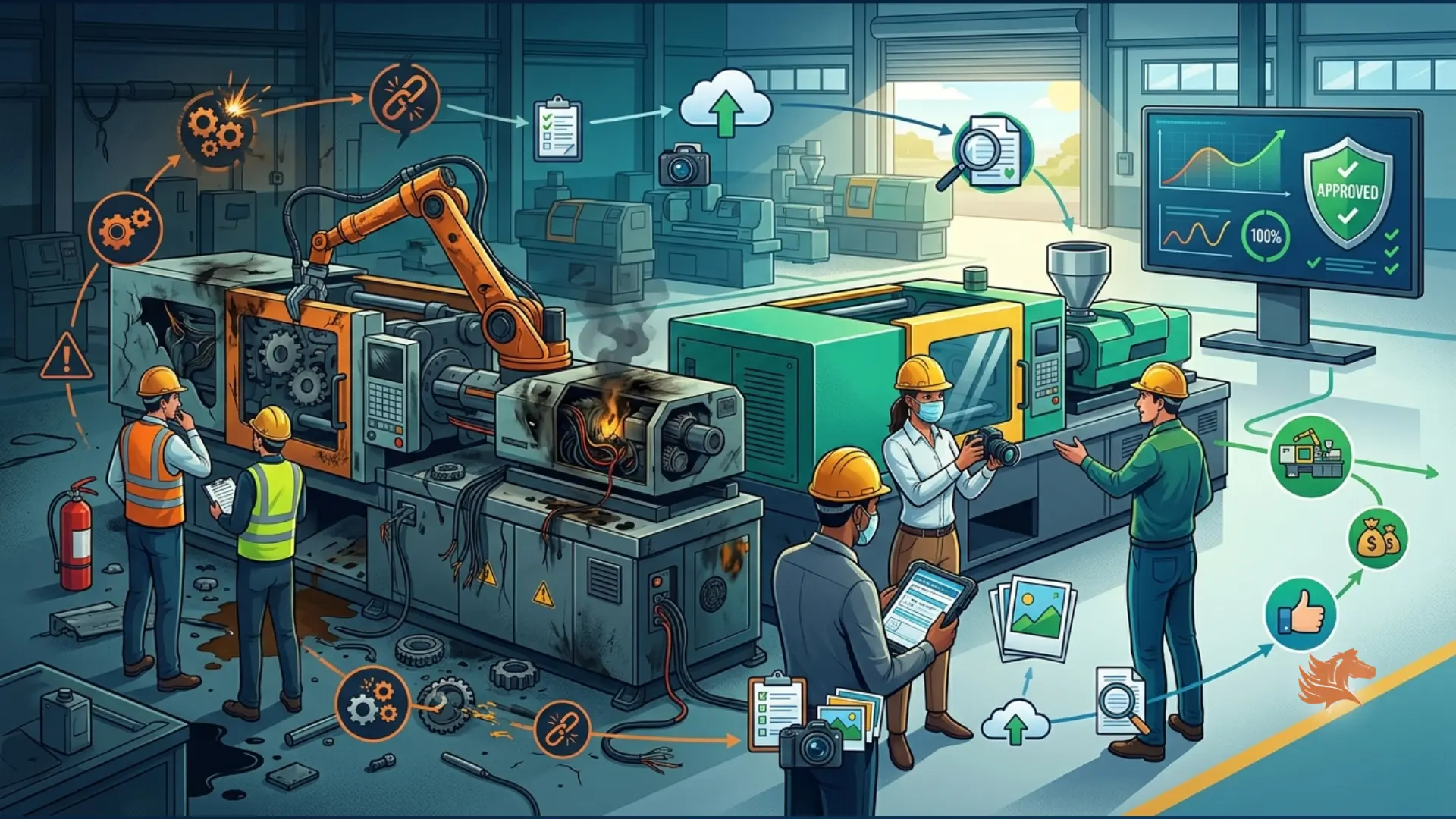
To file a successful commercial insurance claim for damaged production machinery, report the damage to your insurer immediately, secure the site to prevent further loss, and document the equipment's condition with photos, videos, and a written incident report before anything is moved or repaired.
A strong claim needs five categories of proof: the asset record containing the make, model, serial number, and purchase value; maintenance and calibration history; policy details such as coverage type, deductible, and exclusions; a repair or replacement estimate from a qualified vendor; and a clear timeline explaining what happened and when.
Claims are often delayed or disputed because of missing maintenance records, unclear cause-of-loss documentation, or a mismatch between the insured value on file and the machine's actual condition. A centralized asset management system like AssetPegasus helps keep these records attached to the asset before a loss occurs.
Why Do Machinery Insurance Claims Get Denied or Delayed?
Insurers do not deny machinery claims arbitrarily. They may deny or delay claims when the available documentation cannot adequately support what happened, how the damage occurred, or whether the equipment was properly maintained.
Missing maintenance records are a common problem. If a policy requires reasonable care and maintenance but there is no service log to prove it, an adjuster may argue that the damage resulted from neglect rather than a covered event.
An unclear cause of loss can create another major issue. A power surge, mechanical breakdown, fire, flood, and operator error may fall under different coverage provisions. A standard property policy may exclude mechanical breakdown unless a boiler and machinery or equipment breakdown endorsement is included.
Outdated asset values can also create disputes. If a machine was insured at a value that does not reflect upgrades, depreciation, or replacement cost, the final payout may be negotiated down or contested.
Delayed reporting weakens a claim because many commercial policies require prompt notice. Waiting days or weeks to report the loss can cause the insurer to question the timeline of the incident.
Inconsistent documentation across departments can further slow the process. When maintenance, finance, and insurance records are stored separately, adjusters may need to request additional evidence before reviewing the claim.
Key Takeaway
A machinery insurance claim becomes more difficult when the organization cannot quickly prove what equipment was damaged, how the damage occurred, whether it was properly maintained, and what the actual financial loss is.
What Documentation Do You Need Before Filing a Machinery Damage Claim?
A successful commercial machinery insurance claim depends on complete, consistent, and well-organized evidence.
The following documents help establish the identity of the damaged machine, its value, its condition before the loss, the cause of the incident, and the amount being claimed.
Document Type
What It Proves
Asset record with make, model, and serial number
Confirms that the exact damaged machine matches the equipment listed on the policy schedule
Purchase invoice and current book value
Establishes the insured value and depreciation basis
Maintenance and calibration history
Shows that the equipment was properly maintained and not neglected
Warranty status
Determines whether manufacturer coverage may apply before insurance is used
Photos and video of the damage
Provides visual proof of the machine's condition immediately after the loss
Incident report with date, time, and cause
Establishes the timeline and suspected cause of the loss
Repair or replacement estimate
Supports the monetary amount being claimed
Insurance policy and endorsements
Confirms coverage type, limits, deductible, coinsurance requirements, and exclusions
Key Takeaway
The strongest claim package connects the damaged machine's identity, value, maintenance history, insurance coverage, incident details, and repair cost in one consistent set of records.
What Mistakes Reduce Machinery Insurance Claim Payouts?
Several avoidable mistakes can weaken a machinery insurance claim or make the settlement process take longer.
Mistake
Impact on Claim
Repairing or scrapping the machine before documentation
Removes physical evidence the adjuster may need to verify the cause and extent of the damage
Having no maintenance log
Allows the insurer to argue that the damage resulted from neglect, potentially reducing or denying the payout
Reporting the loss late
Can trigger a failure-to-provide-prompt-notice dispute or denial
Using outdated insured values
May lead to underpayment compared with the actual replacement cost
Providing a vague cause-of-loss description
Creates ambiguity that can be used to dispute the applicable coverage type
Submitting documents separately over time
Slows adjuster review and increases back-and-forth requests
Key Takeaway
Document the loss first, report it promptly, use accurate asset values, explain the incident factually, and submit a complete documentation package instead of sending records piecemeal.
1
Secure the Site and Prevent Further Damage
Stop production around the affected machine and isolate it if there is a risk of fire, electrical fault, fluid leakage, or another hazard.
Most commercial insurance policies require the insured to take reasonable steps to prevent additional loss. Failing to do so can reduce the payout even when the original claim might otherwise be valid.
The site should be made safe without unnecessarily disturbing evidence that may be needed by the insurer or claims adjuster.
2
Report the Loss to Your Insurer Immediately
Notify your insurer or broker as soon as the machinery damage is discovered.
Prompt-notice clauses in commercial property and equipment breakdown policies mean that delays of even a few days may be used to question the claim timeline.
Record when the damage was discovered, when the insurer was contacted, who was notified, and any claim reference number provided.
3
Document the Damage Before Anything Is Moved
Photograph and record video of the machine from multiple angles before repairs begin or debris is cleared.
Capture close-ups of the specific failure point, surrounding equipment, and any visible indication of the cause, such as water intrusion, scorching, or a broken component.
The documentation should preserve the equipment's condition immediately after the loss and should be stored with the related incident record.
Photograph the Entire Machine
Capture the machine from multiple angles to show its overall condition and surrounding environment.
Capture the Failure Point
Take close-up photographs and videos of the damaged component or visible failure area.
Document Surrounding Equipment
Record the condition of nearby machinery and any related damage.
Record Visible Cause Indicators
Capture evidence such as water intrusion, scorching, broken components, or other observable signs.
Key Takeaway
Do not repair, dismantle, or dispose of damaged machinery before the condition has been properly documented and, where required, inspected by the adjuster.
4
Pull the Asset's Full Record
Gather the machine's serial number, purchase date, current value, warranty status, and complete maintenance and calibration history.
This information is one of the most important parts of a machinery insurance claim because it directly addresses the insurer's central question: was the machine properly maintained before the loss?
Serial Number
Confirm the exact identity of the damaged machine.
Purchase Date
Establish when the machine was acquired.
Current Value
Provide the current recorded value and relevant valuation information.
Warranty Status
Determine whether manufacturer or vendor warranty coverage may apply.
Maintenance and Calibration History
Show that the machine received the required maintenance and calibration activities.
5
Get an Independent Repair or Replacement Estimate
Have a qualified technician assess the damage and provide a written repair or replacement estimate.
Where possible, use a manufacturer-authorized technician or an appropriately qualified third-party service provider.
Insurers may give greater weight to documented third-party estimates than to internal assumptions. A clear estimate can also speed up settlement discussions.
Key Takeaway
A qualified written estimate supports the amount being claimed and helps the insurer understand whether repair or replacement is the appropriate solution.
6
Write a Clear, Factual Incident Report
Record what happened, when it happened, who discovered the damage, and the suspected cause of the incident.
Use observed facts rather than assumptions or speculative explanations.
For example, write that the control panel displayed a fault code at 6:42 AM instead of stating that the machine probably overheated.
Date and Time
Record when the incident occurred or when the damage was discovered.
Person Who Discovered the Damage
Identify the employee or team that first noticed the issue.
Observed Conditions
Document visible damage, warning messages, fault codes, sounds, leaks, or other verifiable facts.
Suspected Cause
Record the suspected cause carefully and distinguish observed evidence from assumptions.
7
Cross-Check the Claim Against Your Policy Wording
Before submitting a claim amount, confirm whether the loss falls under property damage, equipment breakdown, or a specific insurance endorsement.
Review the applicable coverage limits, deductible, coinsurance requirements, and maintenance-related exclusions.
A standard commercial property policy may cover external causes such as fire, water, or storm damage, while mechanical or electrical failure originating inside the machine may require separate equipment breakdown coverage.
Key Takeaway
The cause of loss must be evaluated against the actual wording of the policy, including endorsements, exclusions, deductibles, and valuation provisions.
8
Submit the Claim With a Complete Documentation Package
Send the asset record, maintenance history, incident report, photos, videos, and repair estimate together rather than submitting documents in separate stages.
A complete initial submission reduces the number of follow-up requests from the adjuster and helps prevent unnecessary delays in the claim review.
Asset Record
Include the machine's make, model, serial number, purchase information, and current value.
Maintenance and Calibration History
Provide evidence of servicing, calibration, and proper equipment care.
Incident Report
Include the factual timeline, discovery details, and suspected cause of loss.
Photos and Videos
Include visual evidence showing the machine's condition after the incident.
Repair or Replacement Estimate
Include the qualified vendor's written estimate supporting the claimed amount.
Policy Documentation
Include the relevant policy, endorsements, coverage limits, deductibles, and exclusions.
9
Track the Claim and Respond to Adjuster Requests Quickly
Assign one internal owner to coordinate communication with the insurer and respond to adjuster questions.
Slow or fragmented internal responses, where the adjuster must contact different departments for different documents, can cause claims to stretch from weeks into months.
The internal claim owner should maintain a record of submitted documents, pending requests, deadlines, communications, inspections, and settlement updates.
Key Takeaway
A single accountable claim owner helps keep documentation organized and ensures that insurer requests are answered quickly and consistently.
How Does Centralized Asset Tracking Improve Machinery Claim Outcomes?
The difference between a claim that settles in weeks and one that continues for months often depends on how quickly the organization can produce a complete and credible record for the specific damaged machine.
A centralized asset management platform like AssetPegasus helps prepare this documentation before a loss occurs.
Each asset record can keep the serial number, purchase value, warranty status, insurance policy details, and complete maintenance and calibration history attached to the machine itself.
When damage occurs, the documentation required by an adjuster is already available in one place instead of being scattered across maintenance logs, finance spreadsheets, and email threads.
Proactive alerts can identify maintenance and calibration due dates before they lapse. This helps protect the argument that the machine was properly maintained, which insurers may scrutinize during claim review.
QR-code lookup allows a facility manager to scan a machine on the production floor and access its complete history instantly. This can help with incident reporting and with demonstrating the equipment's documented condition before the loss.
Because insurance tracking is integrated into the platform, policy details, coverage limits, and renewal dates can be maintained alongside the maintenance record for the same asset.
Centralized Maintenance History
Maintenance and calibration records remain attached to the relevant machine instead of being scattered across departments.
Accurate Insured Values
Purchase values and asset information can be updated as the equipment changes over time.
Connected Insurance Details
Policy details, coverage limits, and renewal dates can be stored with the asset's other records.
Proactive Maintenance Alerts
Alerts help teams identify upcoming maintenance and calibration activities before they become overdue.
QR-Code Asset Lookup
QR codes can provide quick access to a machine's digital record from the production floor.
Key Takeaway
Centralized asset tracking prepares the evidence needed for an insurance claim before the loss occurs, reducing the pressure to reconstruct records after an incident.
Manual Claims Process vs. Centralized Asset Tracking
Requirement
Manual: Spreadsheets, Email, Paper
Centralized: AssetPegasus
Maintenance history retrieval
Scattered across technicians and departments
Instantly available and attached to the asset
Proof that the machine was properly maintained
Difficult to assemble quickly
Continuously logged and organized
Insured value accuracy
Often outdated
Tracked and updated with the asset record
Documentation for adjuster
Assembled reactively after the loss
Centralized before the loss occurs
Time to complete claim package
Days to weeks
Hours
Key Takeaway
Centralized asset tracking reduces the time and effort required to assemble a machinery insurance claim package and helps organizations maintain more reliable evidence.
Conclusion
A commercial insurance claim for damaged production machinery succeeds or fails on documentation speed and completeness, not only on whether the damage is genuinely covered. Securing the site, reporting promptly, documenting the damage before it is disturbed, and submitting a complete package with maintenance history, asset value, and a qualified repair estimate are key steps in the process. Centralizing this documentation before a loss occurs, rather than assembling it under pressure afterward, helps separate a smooth claim from a contested one.
Be Ready Before the Next Machinery Insurance Claim
Start a free 30-day trial with AssetPegasus and keep every machine's maintenance history, warranty status, and insurance details in one record — ready when you need to file a claim.