Out of Warranty & Overpriced: How Hospitals Pay Twice for Medical Device Repairs
By AssetPegasus Team•September 19, 2026
Quick Answer
Hospitals can end up paying unnecessary medical equipment repair costs when warranty, insurance, service-contract, maintenance, and purchase information is scattered across spreadsheets, emails, documents, and vendor portals. When an expensive device fails, staff may initiate a repair before checking whether the equipment is still covered.
Medical equipment warranty tracking software connects each asset to its warranty, insurance, service-contract, maintenance, and repair information. Before authorizing an expensive repair, hospital staff can identify the exact asset, verify applicable coverage, review maintenance history, and determine the appropriate service route.
With AssetPegasus, hospital staff can scan the QR code attached to a physical medical asset using a smartphone and access its digital asset record, including warranty and insurance information. The objective is simple: check coverage before paying for service.
Why Do Hospitals Pay Out-of-Pocket for Repairs That May Be Covered?
Medical equipment generates a large amount of documentation throughout its lifecycle.
A hospital may have purchase invoices in the procurement department, warranty certificates in email, service contracts with the biomedical engineering team, insurance policies with finance or risk management, maintenance records in another system, repair history maintained by technicians, and equipment information stored in spreadsheets.
The problem is not necessarily that the information does not exist. The problem is finding the right information when a device suddenly fails.
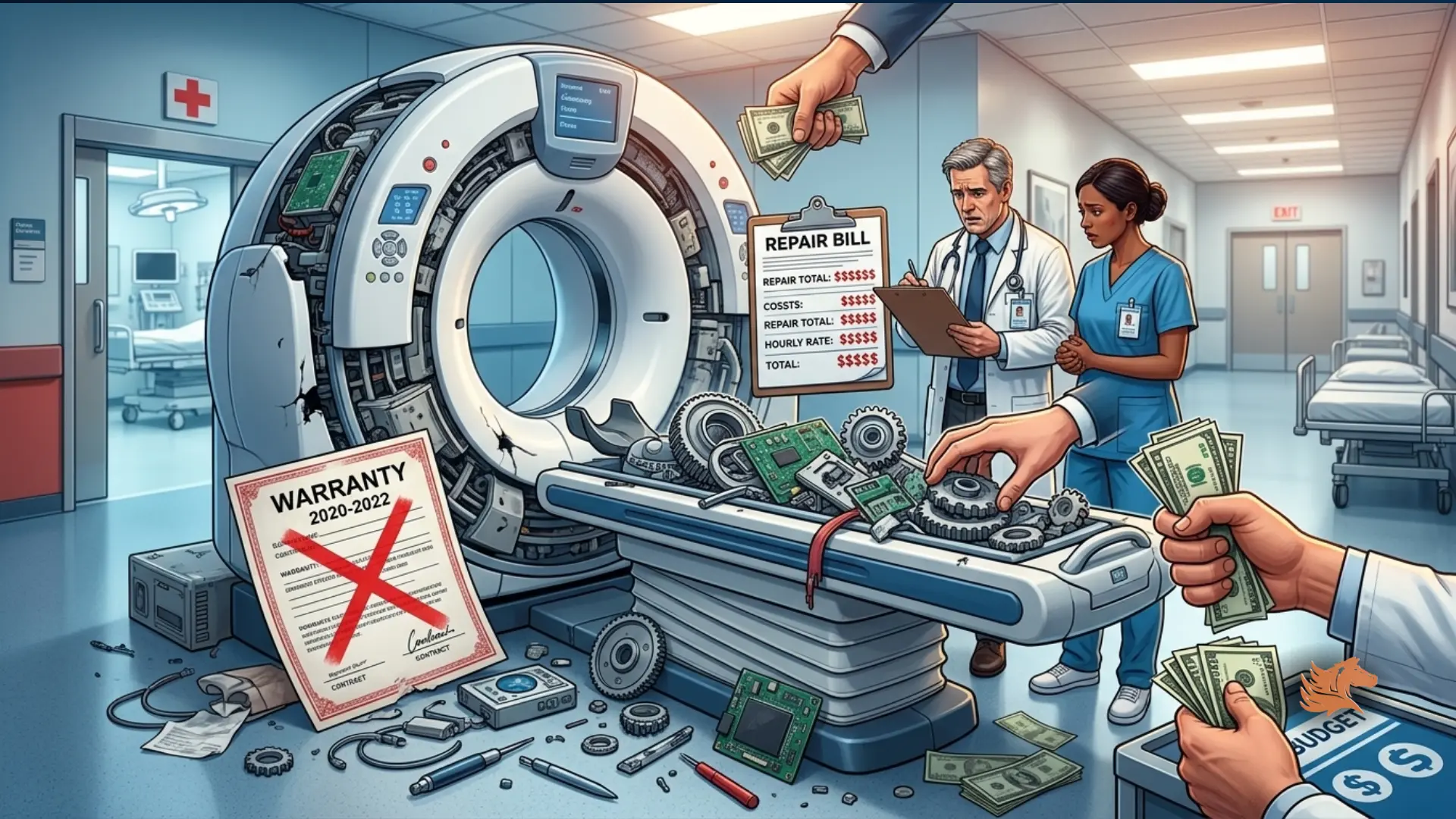
A broken MRI, CT scanner, laboratory analyzer, patient monitor, or other critical device creates pressure to restore service quickly. Staff may contact a technician first and investigate coverage later.
By then, the repair process may already be underway. Manufacturer and service documentation may also require detailed equipment identification, including manufacturer, model, serial number, service performed, and parts replaced.
Key Takeaway
Hospitals can have all the necessary coverage information but still pay unnecessary repair costs when that information cannot be found quickly when equipment fails.
The Real Problem: Warranty Information Is Separated From the Asset
Consider a hospital with several hundred or thousands of medical devices.
A CT scanner, for example, may have a manufacturer warranty, extended warranty, preventive maintenance agreement, service contract, insurance policy, calibration requirements, and previous repair records.
If these records are maintained separately, a technician looking at the physical machine may not know which coverage applies.
This creates a dangerous workflow: equipment fails, a technician receives the service request, a vendor is contacted, the repair is approved, the invoice arrives, and coverage is investigated afterward.
A more effective workflow is to check the asset record first, verify warranty, service-contract, and insurance information, and then select the appropriate service route.
That difference can affect thousands of dollars on a single repair.
Key Takeaway
Connecting warranty and coverage information directly to the medical asset changes the process from investigating coverage after a repair to verifying coverage before approving service.
How Hospitals End Up Paying Twice for Medical Device Repairs
Paying twice does not necessarily mean a hospital literally pays the same invoice twice. It can happen when a hospital pays for a repair that could have been covered, chooses the wrong service route, overlooks an existing service agreement, allows coverage to expire, or repeatedly spends staff time searching for the same information.
Situation
How Additional Cost Can Occur
Repair That Was Covered
A device may still have active manufacturer or extended warranty coverage, but nobody verifies it before the service call.
Wrong Service Route
An external repair provider may be used when an OEM or contracted service provider is required under the applicable agreement.
Missing Service Contract Coverage
A biomedical service agreement may cover labor, components, inspections, or preventive maintenance, but staff may treat the repair as an ordinary emergency expense if the contract is not connected to the asset.
Coverage Expiration
A warranty or service contract can expire because nobody is monitoring its end date.
Repeated Information Searches
Technicians, procurement teams, finance departments, and administrators may each spend time searching for the same equipment documents.
Key Takeaway
Repair costs are not the only financial issue. Missing coverage information can also create unnecessary administrative work across biomedical, procurement, finance, and administrative teams.
Why Does Warranty Tracking Matter for Medical Equipment?
Medical equipment management is not only about knowing where a device is.
Hospitals also need to know what equipment they own, which department uses it, when it was purchased, its serial number and asset ID, its maintenance history, when preventive maintenance is due, whether calibration is required, whether a warranty is active, whether an insurance policy applies, whether a service contract exists, and when coverage expires.
The Joint Commission's published guidance emphasizes maintaining medical equipment inventories and documenting inspection, testing, and maintenance activities. For hospitals using its accreditation process for deemed status purposes, all medical equipment is included in the written inventory.
This makes centralized asset information useful not only for financial control but also for operational and documentation workflows.
Equipment Inventory
Maintain a clear record of the medical equipment owned and managed by the hospital.
Department Assignment
Identify which hospital department uses the equipment.
Asset Identification
Maintain the asset ID, manufacturer, model, and serial number.
Maintenance History
Keep previous maintenance and repair information connected to the equipment.
Identify whether calibration is required for the equipment.
Warranty Status
Determine whether manufacturer or extended warranty coverage is active.
Insurance Coverage
Identify whether an applicable insurance policy covers the equipment.
Service Contracts
Track biomedical, OEM, or other applicable service agreements.
Coverage Expiration
Monitor warranty, insurance, and service-contract expiration dates.
Key Takeaway
A medical asset record should contain more than ownership information. Coverage, maintenance, service, identification, and lifecycle information can all affect how equipment is managed.
What Should a Hospital Check Before Authorizing an Expensive Repair?
Before approving a major repair, the responsible team should verify the asset's coverage information and establish the exact equipment involved.
Step 1: Identify the Exact Asset
Confirm the asset ID, manufacturer, model, serial number, department, and physical location.
Step 2: Check Warranty Status
Determine whether the manufacturer's original warranty or an extended warranty is still active.
Step 3: Check Service Contracts
Look for biomedical service agreements, OEM contracts, or other applicable maintenance arrangements.
Step 4: Check Insurance Coverage
Determine whether the failure or damage could fall under an applicable insurance policy, subject to its terms, exclusions, deductibles, and claim requirements.
Step 5: Review Maintenance History
Check previous repairs and preventive maintenance records before approving the next service action.
Step 6: Document the Decision
Record why the selected service route was used and retain the relevant service documentation.
Key Takeaway
A pre-repair coverage verification process helps connect the physical medical device with its financial, insurance, service, and maintenance records before a major repair is authorized.
How Does AssetPegasus Help Hospitals Control Medical Equipment Repair Costs?
AssetPegasus is designed to connect physical assets with their digital records.
Instead of searching through separate warranty documents, insurance files, service contracts, and maintenance records, authorized hospital staff can access relevant information from the centralized asset record.
Built-In Warranty Tracking
Maintain warranty information alongside the medical asset record so staff can check applicable coverage without searching separate documents.
Hospital Machinery Insurance Tracking
Associate insurance information with the relevant physical asset and use it as another coverage checkpoint before a costly repair or replacement decision.
Biomedical Service Contract Management
Connect service agreements and maintenance information to the equipment record so biomedical and facilities teams can understand what coverage exists before arranging service.
QR Code Asset Lookup
Scan the QR code attached to a medical device using a smartphone to quickly access its digital asset information.
Maintenance History in the Same Record
Review previous service activity and maintenance information before approving another repair.
Expiration Tracking
Monitor warranty and insurance expiration dates alongside other asset deadlines.
Multi-Department Asset Visibility
Provide a centralized view of equipment records across departments such as radiology, laboratory, ICU, emergency, surgery, and outpatient services.
Key Takeaway
The objective is to make coverage, maintenance, service, and asset information available at the point where hospital staff need to make a repair decision.
Manual Warranty Tracking vs. AssetPegasus
When warranty, insurance, service-contract, and maintenance information is maintained across disconnected documents, staff may need to search multiple systems before approving a repair.
A centralized asset record provides another approach by connecting the relevant information directly to the equipment.
Requirement
Manual / Spreadsheet Tracking
AssetPegasus
Warranty information
Separate files and emails
Linked to asset record
Insurance information
Separate documentation
Connected to asset
Service contracts
Vendor documents / spreadsheets
Centralized asset information
Repair decision
Coverage may be checked later
Coverage can be checked first
Asset identification
Manual lookup
QR code scanning
Maintenance history
Separate records
Connected to asset lifecycle
Expiration dates
Calendar/spreadsheet reminders
Centralized tracking
Multi-department visibility
Fragmented
Centralized cloud system
Key Takeaway
Connecting coverage and maintenance information to the asset can reduce the need for repeated document searches and make pre-repair verification easier.
The Financial Question Hospitals Should Ask Before Every Major Repair
When a high-value medical device fails, the first question should not only be how quickly the equipment can be repaired.
Hospitals should also ask: what coverage applies to this asset?
A hospital may have purchased warranty protection, extended service coverage, insurance, or maintenance agreements precisely to control future equipment costs.
But coverage only helps when the organization can identify it at the moment it matters.
Centralizing warranty, insurance, service-contract, maintenance, and asset information turns that check into a repeatable process.
Key Takeaway
Before approving an expensive medical equipment repair, verify what warranty, service-contract, insurance, and maintenance coverage applies to the specific asset.
How Can Medical Equipment Warranty Tracking Improve Repair Cost Control?
Hospitals cannot prevent every medical equipment failure. They can, however, improve the process that happens after a device fails.
When warranty certificates, insurance policies, service contracts, maintenance records, and equipment information are scattered across different systems, expensive coverage can be overlooked.
Medical equipment warranty tracking software provides a structured way to connect coverage information with the physical equipment it protects.
With AssetPegasus, hospital teams can scan an asset QR code, access its digital record, review warranty and insurance information, check maintenance history, and make a more informed decision before authorizing service.
The objective is not simply to track equipment. It is to make sure the hospital knows what it is paying for and what coverage it already has before the repair bill arrives.
Key Takeaway
Warranty tracking becomes more valuable when warranty, insurance, service, maintenance, and asset information are connected to the same medical device record.
Conclusion
Hospitals cannot prevent every medical equipment failure, but they can improve what happens when a device fails. When warranty certificates, insurance policies, service contracts, maintenance records, and equipment information are scattered across different systems, expensive coverage can be overlooked. Connecting these records to the individual medical asset gives hospital teams a structured way to identify applicable coverage, review maintenance history, verify service arrangements, and make a more informed repair decision before an invoice arrives.
Stop Paying Repair Bills Without Checking Coverage
Track medical equipment, warranties, insurance, maintenance, service history, and asset information in one centralized system with AssetPegasus. Start your free 30-day trial and bring warranty visibility directly to the equipment floor.