What Happens to Facility Assets When Key Staff Leave?
By Asset Pegasus Team•October 7, 2026
Quick Answer
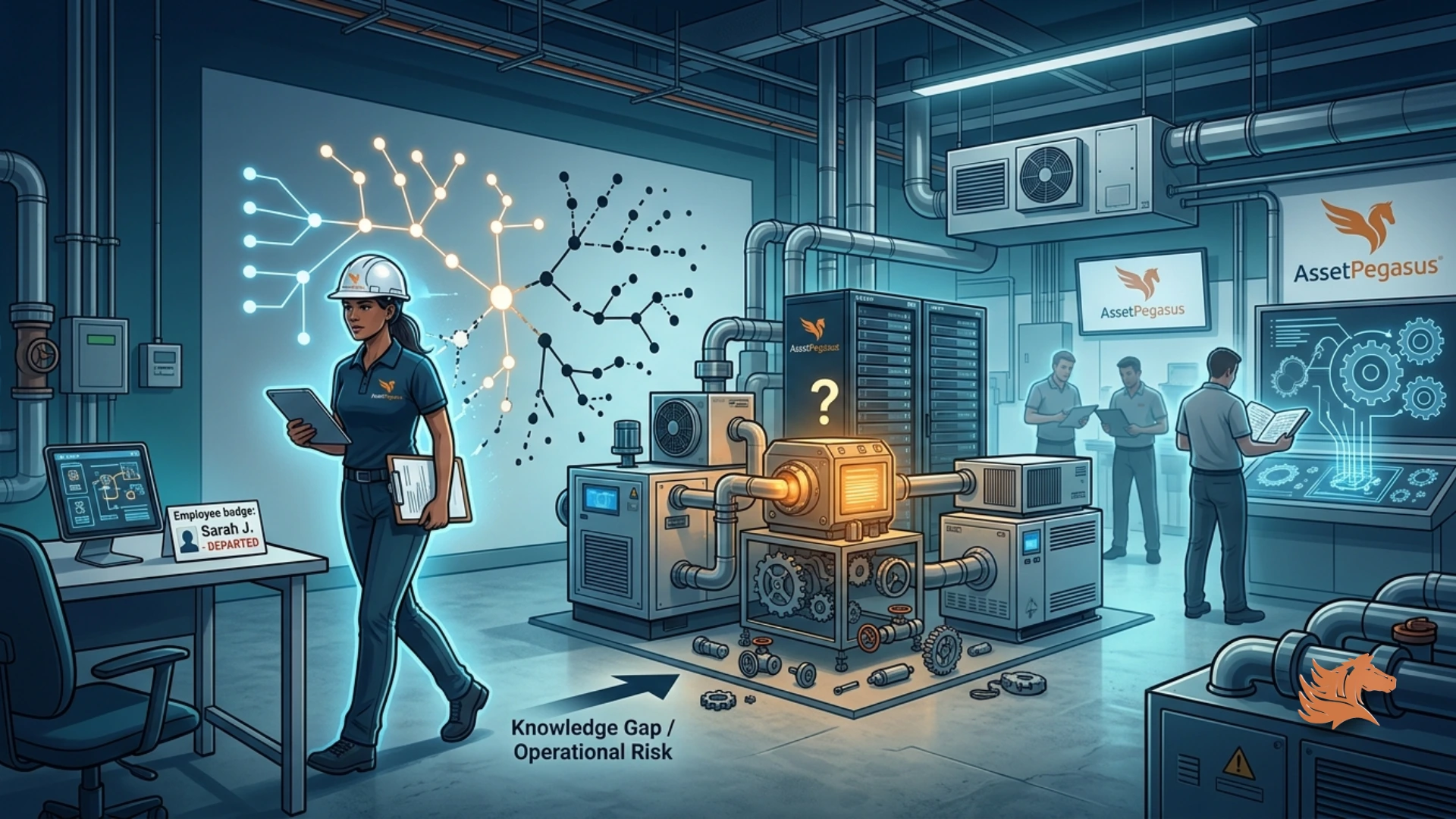
When key facility staff leave, critical asset knowledge can leave with them. Equipment may still exist, but information about its location, condition, maintenance history, warranty, insurance, vendors, and service schedule can become difficult to recover.
Centralized facility asset management software prevents this knowledge from remaining inside one employee's memory, spreadsheet, inbox, or filing cabinet.
AssetPegasus keeps important information connected to the asset record, giving authorized team members a consistent source of truth even when facilities managers, maintenance staff, contractors, or other responsible personnel change.
Why Does Staff Departure Create an Asset Management Problem?
Facilities depend on people who build operational knowledge over time. A maintenance manager may know which HVAC unit has recurring problems, which vendor services a generator, or where warranty documents are stored.
That knowledge is valuable—but if it is undocumented, it becomes a business risk. When an experienced employee leaves, the replacement can inherit equipment without inheriting its complete history.
The equipment itself may remain inside the organization, but the operational knowledge surrounding that equipment can become difficult to recover.
Unknown Asset Locations
Replacement staff may not know where specific equipment is currently located or which department is using it.
Missing Maintenance Records
Previous service activity and preventive maintenance information may be difficult to reconstruct.
Forgotten Warranty or Insurance Information
Coverage information may be overlooked when warranty or insurance records are stored in individual files, inboxes, or documents.
Unclear Vendor and Service-Contract Details
New staff may not know which vendor services particular equipment or what contractual arrangements already exist.
Missed Preventive Maintenance
Upcoming maintenance requirements can be overlooked when schedules depend on the knowledge of a specific employee.
Duplicate Purchases
Poor asset visibility can contribute to unnecessary purchases when existing equipment cannot be located or verified.
Longer Troubleshooting Time
New employees may spend additional time reconstructing equipment history before they can diagnose recurring problems.
Key Takeaway
The equipment does not disappear when an employee leaves, but the knowledge surrounding that equipment can disappear if it was never centrally documented.
What Is the Knowledge Gap Behind Facility Asset Loss?
Consider a facility with HVAC systems, generators, pumps, compressors, electrical equipment, computers, and tools.
The former facilities manager may have known which generator needs service, which HVAC unit is under warranty, which vendor has the service agreement, and which equipment is due for replacement.
If those details exist only in emails, spreadsheets, paper files, or memory, the organization has a single-person dependency.
When that employee leaves, a new employee may have to reconstruct information that should have been immediately available.
Key Takeaway
Facility asset knowledge becomes an operational risk when critical information depends on one person's memory, inbox, spreadsheets, or files.
Why Aren't Excel and Shared Folders Enough for Facility Asset Management?
Spreadsheets and shared folders can store asset information, but they do not automatically create a complete operational history.
A spreadsheet might show a basic record such as Generator-014, Main Facility, Active.
But the team may also need the equipment's serial number, purchase date, service history, next maintenance date, warranty or insurance status, vendor, repairs, and supporting documents.
When these details are distributed across different files and systems, staff turnover makes reconstruction harder.
A centralized asset record gives the next employee the context, not just the asset name.
Basic Asset Record
Operational Information Also Needed
Asset ID
Serial number and identification details
Location
Department and responsible person or team
Status
Condition and lifecycle history
Purchase information
Purchase date and supporting records
Maintenance
Service history and next maintenance date
Coverage
Warranty and insurance status
Vendor
Service provider and contract details
Documents
Supporting asset and service documentation
Key Takeaway
A basic spreadsheet can identify an asset, but replacement staff need the operational context surrounding that asset to manage it effectively.
What Should Happen When a Key Facility Employee Leaves?
A strong asset management process should make employee departure a transition event—not an information-loss event.
Asset responsibility and operational knowledge should remain with the organization even when the employee who previously managed the equipment is no longer there.
1. Transfer Asset Responsibility
Every asset should have a clear department, location, and responsible person or team. This makes ownership easier to transfer when an employee leaves.
2. Preserve Maintenance History
Service records, repairs, and preventive maintenance schedules should remain attached to the asset instead of being stored only with the employee who managed them.
3. Protect Warranty and Insurance Information
Warranty dates, insurance policies, coverage details, and renewal information should remain accessible to authorized staff. This helps prevent unnecessary repair or replacement costs.
4. Keep Vendor and Contract Details
Service vendors, contract information, renewal dates, and supporting documents should be linked to the relevant asset.
5. Maintain Complete Asset History
The organization should be able to see an asset's lifecycle, including purchase, assignment, transfer, maintenance, repair, warranty, insurance, and current status.
Key Takeaway
A structured asset management process turns employee knowledge into organizational knowledge that survives staff transitions.
How Does AssetPegasus Prevent Facility Asset Knowledge Loss?
AssetPegasus provides a centralized system for managing physical and digital assets throughout their lifecycle.
Instead of depending on the memory or files of an individual employee, important equipment information can remain connected to the asset itself.
One Record Per Asset
Each asset can have a structured record containing identification, location, status, history, maintenance, warranty, insurance, and supporting information.
QR-Based Asset Access
A QR code attached to a physical asset can allow authorized staff to access its digital record using a smartphone. A new employee can identify unfamiliar equipment without depending on the previous manager's memory.
Maintenance and Service History
Maintenance and repair information stays connected to the asset, helping new facilities staff understand what has already been done and what needs attention.
Warranty and Insurance Visibility
Coverage information remains associated with the asset, helping teams check warranty or insurance status before approving costly repairs or replacements.
Asset Lifecycle History
A centralized history creates continuity when employees change.
Key Takeaway
Keeping operational information connected to individual asset records reduces dependence on the knowledge of any single facilities employee.
How Do You Turn Employee Knowledge Into Organizational Asset Knowledge?
The objective of facility asset management is not simply to create an inventory. It is to make asset knowledge transferable.
Employees leave. Managers change. Contractors change. Facilities expand. Equipment moves between departments and locations.
Asset records should survive all of those changes.
A well-maintained asset management system means a new facilities manager does not have to start from zero. They inherit a structured operational history and can make decisions using documented information.
Employee-Dependent Knowledge
Centralized Organizational Knowledge
Equipment location remembered by a manager
Location recorded against the asset
Maintenance history stored in emails
Maintenance history connected to the asset
Warranty documents in personal folders
Warranty information available in the asset record
Insurance details known by one employee
Insurance information associated with the equipment
Vendor contacts remembered by staff
Vendor and service details centrally documented
Maintenance schedule tracked manually
Maintenance requirements preserved with the asset
Asset history reconstructed after departure
Lifecycle history continuously maintained
Key Takeaway
The goal is to make facility asset knowledge transferable so staff changes do not force the organization to reconstruct equipment history.
What Information Should a Facility Asset Management System Track?
A facility asset management system should preserve enough information for replacement staff to understand what an asset is, where it is, who is responsible for it, what has happened to it, and what needs to happen next.
Asset Identification
Maintain identifying information that allows staff to distinguish and verify individual equipment.
Location
Record where the asset is currently located.
Department
Associate equipment with the relevant department or operational area.
Responsible Person or Team
Identify who currently has operational responsibility for the asset.
Asset Status
Maintain the current status of the equipment.
Purchase Information
Preserve relevant purchase information as part of the asset record.
Maintenance and Repairs
Keep service activity, preventive maintenance, and repair information connected to the equipment.
Warranty and Insurance
Maintain applicable warranty, insurance, coverage, and renewal information.
Vendors and Documents
Keep vendor information and supporting documentation associated with the relevant asset.
Transfers and Lifecycle History
Preserve transfers and other lifecycle events so replacement staff can understand how the asset has changed over time.
Key Takeaway
A complete facility asset record provides both current information and historical context instead of functioning as a simple inventory list.
Why Is Asset History Important When Facility Staff Change?
Asset history gives replacement staff the operational context they need without relying on the previous employee's memory.
Knowing that a piece of equipment exists is only the beginning. A new facilities manager may also need to understand previous repairs, recurring maintenance problems, warranty or insurance coverage, past assignments, transfers, and current status.
When that history remains attached to the asset, staff transitions do not require the organization to reconstruct years of operational information from emails, spreadsheets, paper files, or conversations.
Key Takeaway
Asset history preserves operational context so replacement staff can understand equipment without depending on undocumented knowledge from previous employees.
How Can Facilities Preserve Asset Knowledge When Staff Leave?
Key staff leaving should not create a blind spot across a facility.
If critical equipment information lives in one employee's memory, inbox, spreadsheet, or filing cabinet, the organization has an operational dependency that can become expensive when that employee leaves.
Centralized facility asset management software helps preserve asset knowledge by keeping location, ownership, maintenance, warranty, insurance, vendor, and lifecycle information connected to each asset.
AssetPegasus helps organizations turn individual employee knowledge into a centralized, accessible asset history—so when people change, the knowledge stays.
Key Takeaway
Facility asset knowledge should remain with the organization rather than leaving with the employee who previously managed the equipment.
Conclusion
Key staff leaving should not create a blind spot across your facility. If critical equipment information lives in one employee's memory, inbox, spreadsheet, or filing cabinet, the organization has an operational dependency that can become expensive when that employee leaves. Centralized facility asset management software helps preserve asset knowledge by keeping location, ownership, maintenance, warranty, insurance, vendor, and lifecycle information connected to each asset. AssetPegasus helps organizations turn individual employee knowledge into a centralized, accessible asset history—so when people change, the knowledge stays.
Know Your Assets. Preserve Their History.
Keep facility asset knowledge with the organization—not with a single employee. Centralize asset records, maintenance, warranties, insurance, and lifecycle history with AssetPegasus.